
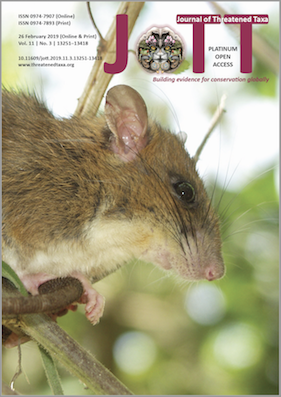
Animal-fungal interactions 3: first report of mycophagy by the African Brush-tailed Porcupine Atherurus africanus Gray, 1842 (Mammalia: Rodentia: Hystricidae)
DOI:
https://doi.org/10.11609/jott.4584.11.3.13415-13418Keywords:
Elaphomyces, fungivory, truffles, Ascomycota, HystricidaeAbstract
Fungi are an important food source for a diversity of animals throughout the world, but these associations have been poorly studied in Africa. In this short note based on an observation from the Congo Basin of Cameroon, we provide the first report of mycophagy by the African brush-tailed porcupine and the first account of the hypogeous fungal genus Elaphomyces being eaten by an animal in Africa.
References
Beenken, L., M.N. Sainge & A. Kocyan (2016). Lactarius megalopterus, a new angiocarpous species from a tropical rainforest in central Africa, shows adaptations to endozoochorous spore dispersal. Mycological Progress 15: 58; https://doi.org/10.1007/s11557-016-1198-4
Bermejo, M., G. Illera & J.S. Pà (1994). Animals and mushrooms consumed by bonobos (Pan paniscus): new records from Lilungu (Ikela), Zaire. International Journal of Primatology 15(6): 879–898; https://doi.org/10.1007/BF02736074
Boudier, M. (1876). Du Parasitisme Probable De Quelques Espèces Du Genre Elaphomyces Et De La Recherche De Ces Tubéracés. Bulletin de la Société Botanique de France 23(3): 115–119.
Caldwell, I. R., K. Vernes & F. Barlocher (2005). The northern flying squirrel (Glaucomys sabrinus) as a vector for inoculation of red spruce (Picea rubens) seedlings with ectomycorrhizal fungi. Sydowia 57(2): 166–178.
Castellano, M.A., A. Verbeken, R. Walleyn & D. Thoen (2000). Some new and interesting sequestrate Basidiomycota from African woodlands. Karstenia 40(1): 11–21.
Castellano, M.A., B. Dentinger, O. Séné, T.F. Elliott, C. Truong & T.W. Henkel (2016a). New species of Elaphomyces (Elaphomycetaceae, Eurotiales, Ascomycota) from tropical rainforests of Cameroon and Guyana. IMA Fungus 7(1): 59–73.
Castellano, M.A., J.M. Trappe & K. Vernes (2011). Australian species of Elaphomyces (Elaphomycetaceae, Eurotiales, Ascomycota). Australian Systematic Botany 24(1): 32–57; https://doi.org/10.1071/SB10012
Castellano, M.A., T.F. Elliott & J.M. Trappe (2018). Three new black Elaphomyces species (Elaphomycetaceae, Eurotiales, Ascomycota) from eastern North America with notes on selected European species. Fungal Systematics and Evolution 1(1): 1–12; https://doi.org/10.3114/fuse.2018.01.01
Castellano, M.A., T.F. Elliott, C. Truong, O. Séné, B. Dentinger, & T.W. Henkel (2016b). Kombocles bakaiana gen. sp. nov. (Boletaceae), a new sequestrate fungus from Cameroon. IMA Fungus 7(2): 239–245.
Castellano, M.A., T.W. Henkel, S.L. Miller, M.E. Smith & M.C. Aime (2012). New Elaphomyces species (Elaphomycetaceae, Eurotiales, Ascomycota) from Guyana. Mycologia 104(5): 1244–1249.
Cázares, E. & J.M. Trappe (1994). Spore dispersal of ectomycorrhizal fungi on a glacier forefront by mammal mycophagy. Mycologia 86(4): 507–510; https://doi.org/10.2307/3760743
Claridge, A.W. & J.M. Trappe (2005). Sporocarp mycophagy: nutritional, behavioral, evolutionary and physiological aspects, pp599–611. In: Dighton, J., J.F. White & P. Oudemans (eds.). The Fungal Community — Its Organization and Role in the Ecosystem. Taylor & Francis, Boca Raton, FL, USA, 936pp.
Claridge, A.W. & T.W. May (1994). Mycophagy among Australian mammals. Austral Ecology 19(3): 251–275; https://doi.org/10.1111/j.1442-9993.1994.tb00489.x
Colgan, W. III & A.W. Claridge (2002). Mycorrhizal effectiveness of Rhizopogon spores recovered from fecal pellets of small forest-dwelling mammals. Mycological Research 106(3): 314–320.
Cooper, T. & K. Vernes (2011). Mycophagy in the larger bodied skinks of the genera Tiliqua and Egernia: are there implications for ecosystem health? Australian Zoologist 35(3): 681–684; https://doi.org/10.7882/AZ.2011.020
Cork, S.J. & G.J. Kenagy (1989). Nutritional value of hypogeous fungus for a forest-dwelling ground squirrel. Ecology 70(3): 577–586; https://doi.org/10.2307/1940209
Corrales, A., S.A. Mangan, B.L. Turner & J.W. Dalling (2016). An ectomycorrhizal nitrogen economy facilitates monodominance in a neotropical forest. Ecology Letters 19(4): 383–392; https://doi.org/10.1111/ele.12570
Dissing, H. & M. Lange (1962). Gasteromycetes of Congo. Bulletin de le Jardin Botanique de l’Etat 32(4): 325–416; https://doi.org/10.2307/3667249
Dring, D.M. & D.N. Pegler (1978). New and noteworthy gasteroid relatives of the Agaricales from tropical Africa. Kew Bulletin 32(3): 563–569; https://doi.org/10.2307/4109660
Elliott, T.F., J.M. Trappe & A. Türkoğlu (2018). Animal-fungal interactions 2: first report of mycophagy by the Eastern European Hedgehog Erinaceus concolor Martin, 1837 (Mammalia: Eulipotyphla: Erinaceidae). Journal of Threatened Taxa 10(9): 12277–12279; https://doi.org/10.11609/jott.4350.10.9.12277-12279
Elliott, T.F. & K. Vernes (2019). Superb Lyrebird Mycophagy, Truffles, and Soil Disturbance. IBIS 161(1): 198–204; https://doi.org/10.1111/ibi.12644
Ferdman, Y., S. Aviram, R.B. Nurit, J.M. Trappe & V. Kagan-Zur (2005). Phylogenetic studies of Terfezia pfeilii and Choiromyces echinulatus (Pezizales) support new genera for southern African truffles: Kalaharituber and Eremiomyces. Mycological Research 109(2): 237–245; https://doi.org/10.1017/S0953756204001789
Fogel, R. & J.M. Trappe (1978). Fungus consumption (mycophagy) by small mammals. Northwest Science 52(1): 1–31.
Fossey, D. (2000). Gorillas in the Mist. Houghton Mifflin Harcourt, Boston, New York, 400pp.
Ganzhorn, J. & P.M. Kappeler (eds.) (1993). Lemur Social Systems and their Ecological Basis. Springer Science & Business Media, Plenum Press, New York, viii+274pp; https://doi.org/10.1007/978-1-4899-2412-4
Genov, P. (1982). Fructification of Elaphomyces granulatus Fr. are food for boars. Acta Mycologica 18(1): 123–125; https://doi.org/10.5586/am.1982.008
Georgiev, A.V., M.E. Thompson, A.L. Lokasola & R.W. Wrangham (2011). Seed predation by Bonobos (Pan paniscus) at Kokolopori, Democratic Republic of the Congo. Primates 52: 309; https://doi.org/10.1007/s10329-011-0256-4
Hailey, A., I.M. Coulson & R.L. Chidavaenzi (1997). Fungus eating by the African tortoise Kinixys spekii. Journal of Tropical Ecology 13(3): 469–474; https://doi.org/10.1017/S0266467400010634
Hanson, A.M., K.T. Hodge & L.M. Porter (2003). Mycophagy among primates. Mycologist 17(1): 6–10; https://doi.org/10.1017/S0269915X0300106X
Heinichen, I.G. (1972). Preliminary notes on the Suni, Nesotragus moschatus and Red Duiker, Cephalophus natalensis. Zoologica Africana 7(1): 157–165; https://doi.org/10.1080/00445096.1972.11447436
Henkel, T.W. (2003). Monodominance in the ectomycorrhizal Dicymbe corymbosa (Caesalpiniaceae) from Guyana. Journal of Tropical Ecology 19(4): 417–437; https://doi.org/10.1017/S0266467403003468
Hussain, G. & I.M. Al-Ruqaie (1999). Occurrence, chemical composition, and nutritional value of truffles: an overview. Pakastan Journal of Biological Sciences 2(2): 510–514.
Isbell, L.A. (1998). Diet for a small primate: insectivory and gummivory in the (large) patas monkey (Erythrocebus patas pyrrhonotus). American Journal of Primatology 45(4): 381–398; https://doi.org/10.1002/(SICI)1098-2345(1998)45:4%3C381::AID-AJP5%3E3.0.CO;2-S
Isbell, L.A. & T.P. Young (2007). Interspecific and temporal variation of ant species within Acacia drepanolobium ant domatia, a staple food of patas monkeys (Erythrocebus patas) in Laikipia, Kenya. American Journal of Primatology 69(12): 1387–1398; https://doi.org/10.1002/ajp.20444
KalaÄ, P. (2009). Chemical composition and nutritional value of European species of wild growing mushrooms: a review. Food Chemistry 113(1): 9–16; https://doi.org/10.1016/j.foodchem.2008.07.077
Mills, M.G.L. (1978). Foraging behaviour of the Brown Hyaena (Hyaena brunnea Thunberg, 1820) in the southern Kalahari. Ethology 48(2): 113–141; https://doi.org/10.1111/j.1439-0310.1978.tb00252.x
Nuske, S.J., K. Vernes, T.W. May, A.W. Claridge, B.C. Congdon, A. Krockenberger & S.E. Abell (2017a). Redundancy among mammalian fungal dispersers and the importance of declining specialists. Fungal Ecology 27(A): 1–13; https://doi.org/10.1016/j.funeco.2017.02.005
Nuske, S.J., K. Vernes, T.W. May, A.W. Claridge, B.C. Congdon, A. Krockenberger & S.E. Abell (2017b). Data on the fungal species consumed by mammal species in Australia. Data in Brief 12: 251–260; https://doi.org/10.1016/j.dib.2017.03.053
Odendaal, P.B. (1983). Feeding habits and nutrition of bushbuck in the Knysna forests during winter. South African Journal of Wildlife Research 13(2): 27–31.
Odendaal, P.B. (1977). Some aspects of the ecology of bushbuck (Tragelaphus scriptus Pallas, 1776) in the Southern Cape. MS in Forestry Dissertation. Stellenbosch University, Stellenbosch, 200pp.
Ori, F., J.M. Trappe, M. Leonardi, M. Iotti & G. Pacioni (2018). Crested porcupines (Hystrix cristata): mycophagist spore dispersers of the ectomycorrhizal truffle Tuber aestivum. Mycorrhiza 28(5–6): 561–565; https://doi.org/10.1007/s00572-018-0840-1
Paz, A., J.M. Bellanger, C. Lavoise, A. Molia, M. Åawrynowicz, E. Larsson, I.O. Ibarguren, M. Jeppson, T. Læssøe, M. Sauve, F. Richard & P.A. Moreau (2017). The genus Elaphomyces (Ascomycota, Eurotiales): a ribosomal DNA-based phylogeny and revised systematics of European ‘deer truffles’. Persoonia - Molecular Phylogeny and Evolution of Fungi 38(1): 197–239; https://doi.org/10.3767/003158517X697309
Peay, K.G., P.G. Kennedy & T.D. Bruns (2008). Fungal community ecology: a hybrid beast with a molecular master. Bioscience 58(9): 799–810; https://doi.org/10.1641/B580907
Peh, K.S.H., B. Sonke, J. Lloyd, C.A. Quesada & S.L. Lewis (2011). Soil does not explain monodominance in a central African tropical forest. PLoS One 6(2): e16996; https://doi.org/10.1371/journal.pone.0016996
Read, D.J. & J. Perez-Moreno (2003). Mycorrhizas and nutrient cycling in ecosystems – a journey towards relevance? New Phytologist 157(3): 475–492; https://doi.org/10.1046/j.1469-8137.2003.00704.x
Schmit, J.P. & G.M. Mueller (2007). An estimate of the lower limit of global fungal diversity. Biodiversity and Conservation 16(1): 99–111; https://doi.org/10.1007/s10531-006-9129-3
Smith, S.E. & D.J. Read (2008). Mycorrhizal Symbiosis. 3rd Edition, Academic Press, London, 800pp.
Tedersoo, L., T.W. May & M.E. Smith (2010). Ectomycorrhizal lifestyle in fungi: global diversity, distribution, and evolution of phylogenetic lineages. Mycorrhiza 20(4): 217–263; https://doi.org/10.1007/s00572-009-0274-x
Trappe, J.M. & A.W. Claridge (2005). Hypogeous fungi: evolution of reproductive and dispersal strategies through interations with animals and plants, pp613–622. In: Dighton, J., J.F. White & P. Oudemans (eds.). The Fungal Community - Its Organization and Role in the Ecosystem. Taylor & Francis, Boca Raton, FL, USA, 936pp.
Trappe, J.M., R. Molina, D.L. Luoma, E. Cázares, D. Pilz, J.E. Smith, M.A. Castellano, S.L. Miller & M.J. Trappe (2009). Diversity, Ecology and Conservation of Truffle Fungi in Forests of the Pacific Northwest. USDA Forest Service. General Technical Report PNW-GTR-772. Pacific Northwest Research Station, Portland OR, USA, 195pp.
Vernes, K. & N. Poirier (2007). Use of a robin’s nest as a cache site for truffles by a red squirrel. Northeastern Naturalist 14(1): 145–149; https://doi.org/10.1656/1092-6194(2007)14%5B145:UOARNA%5D2.0.CO;2
Vernes, K., M. Castellano & C.N. Johnson (2001). Effects of season and fire on the diversity of hypogeous fungi consumed by a tropical mycophagous marsupial. Journal of Animal Ecology 70(6): 945–954; https://doi.org/10.1046/j.0021-8790.2001.00564.x
Vernes, K., S. Blois & F. Bärlocher (2004). Seasonal and yearly changes in consumption of hypogeous fungi by northern flying squirrels and red squirrels in old-growth forest, New Brunswick. Canadian Journal of Zoology 82(1): 110–117; https://doi.org/10.1139/z03-224
Vogt, K.A., R.L. Edmonds & C.C. Grier (1981). Biomass and nutrient concentrations of sporocarps produced by mycorrhizal and decomposer fungi in Abies amabilis stands. Oecologia 50(2): 170–175; https://doi.org/10.1007/BF00348033
Wallis, I., A.W. Claridge & J.M. Trappe (2012). Nitrogen content, amino acid composition and digestibility of fungi from a nutritional perspective in animal mycophagy. Fungal Biology 116(5): 590–602; https://doi.org/10.1016/j.funbio.2012.02.007
Downloads
Published
Issue
Section
License
Authors own the copyright to the articles published in JoTT. This is indicated explicitly in each publication. The authors grant permission to the publisher Wildlife Information Liaison Development (WILD) Society to publish the article in the Journal of Threatened Taxa. The authors recognize WILD as the original publisher, and to sell hard copies of the Journal and article to any buyer. JoTT is registered under the Creative Commons Attribution 4.0 International License (CC BY), which allows authors to retain copyright ownership. Under this license the authors allow anyone to download, cite, use the data, modify, reprint, copy and distribute provided the authors and source of publication are credited through appropriate citations (e.g., Son et al. (2016). Bats (Mammalia: Chiroptera) of the southeastern Truong Son Mountains, Quang Ngai Province, Vietnam. Journal of Threatened Taxa 8(7): 8953–8969. https://doi.org/10.11609/jott.2785.8.7.8953-8969). Users of the data do not require specific permission from the authors or the publisher.