
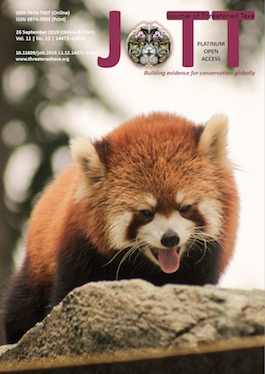
The first photographic record of the Red Panda Ailurus fulgens (Cuvier, 1825) from Lamjung District outside Annapurna Conservation Area, Nepal
DOI:
https://doi.org/10.11609/jott.4828.11.12.14576-14581Keywords:
Ailurus fulgens, distribution, Lamjung District, Nepal, Red PandaAbstract
In May and June, 2018, a series of field surveys was undertaken to determine the presence of the Red Panda Ailurus fulgens in Marsyangdi Rural Municipality in Lamjung District, western Nepal. A single, adult, Red Panda was photographed and recorded on video at Nafada Khola while scratch marks and distinctive scats provided evidence of Red Panda activity at eleven further localities at elevations between 3,150 and 3,650 m. Threats to the habitat of A. fulgens within the study area are discussed.
References
Baral, B. (2014). Baseline study of Red Panda (Ailurus fulgens fulgens, Cuvier 1825) in Jajarkot district, Midâ€Western Nepal. Master’s Thesis. Central Department of Environmental Science, Tribhuvan University, Kathmandu, Nepal, 52pp.
Bista, D. & R. Paudel (2014). An overview of the status and conservation initiatives of Red Panda Ailurus fulgens (Cuvier, 1825) in Nepal. The Initiation 05: 171–181.
Bista, D., S. Shrestha, P. Sherpa, G.J. Thapa, M. Kokh, S.T. Lama & S.R. Jnawali (2017). Distribution and habitat use of Red Panda in the Chitwan-Annapurna Landscape of Nepal. PloS one 12(10): e0178797.
CBS (2011). National Population and Housing Census 2011. Central Bureau of Statistics. National Planning Commission Secretariat, Kathmandu, Nepal, 262pp.
Cuvier, F.G. (1825). Panda. In: Geoffroy Saint-Hilaire, E. & F.G. Cuvier (eds.). Histoire naturelle des mammifères: avec des figures originales, coloriées, dessinées d’après des animaux vivans. A. Belin, Paris, 5(50): 3pp.
Dangol, B. (2014). Habitat and Distribution of Red Panda: A case from Ranchuli VDC Kalikot District, Nepal. Master’s Dissertation. Central Department of Environmental Science, Tribhuvan University, Kathmandu, Nepal, 33pp.
DDC (District Development Committee, Lamjung) (2011). District Profile of Lamjung. District Development Committee, Lamjung, Nepal.
DNPWC and DFSC (2018). Red Panda Conservation Action Plan for Nepal (2019–2023). Department of National Parks and Wildlife Conservation and Department of Forests and Soil Conservation, Kathmandu, Nepal
Fox, J., P.B. Yonzon & N. Podger (1996). Mapping conflicts between biodiversity and human needs in Langtang National Park, Nepal. Conservation Biology 10(20): 562–569.
Glatston, A., F. Wei, Z.Than & A. Sherpa (2015). Ailurus fulgens. (errata version published in 2017). The IUCN Red List of Threatened Species 2015: e.T714A110023718. Downloaded on 19 September 2019. https://doi.org/10.2305/IUCN.UK.2015-4.RLTS.T714A45195924.en
DNPWC and DFSC (2018). Red Panda Conservation Action Plan for Nepal (2019–2023). Department of National Parks and Wildlife Conservation and Department of Forests and Soil Conservation, Kathmandu, Nepal.
Jackson, R. (1990). Threatened wildlife, crop and wildlife depredation and grazing in the Makalu Barun National Park and Conservation Area. Department of National Parks and Wildlife Conservation, Kathmandu, Nepal. 105pp.
Jnawali, S., K. Leus, S. Molur, A. Glatston & S. Walker (Eds.) (2012). Red Panda (Ailurus fulgens). Population and Habitat Viability Assessment (PHVA) and Species Conservation Strategy (SCS) Workshop Report. National Trust for Nature Conservation, Kathmandu, Nepal, Conservation Breeding Specialist Group and Zoo Outreach Organization, Coimbatore, India. 66pp.
Mahato, N.K. (2004). Status of Red Panda (Ailurus fulgens) in Kangchenjunga region of Nepal. Tigerpaper 31: 7–9.
Mahato, N.K., & J.B. Karki (2005). Distribution and habitat assessment of Red Panda (Ailurus fulgens) in Kanchenjunga Conservation Area with reference to Riya Samba and Lama Khanak forests. Nepal Journal of Forestry 12: 32–40.
Mali, N. (2014). Status and Conservation Threats of Red Panda in Chiuridada and Nirmalidada VDCs of Khotang District, Nepal. Master’s Dissertation. Central Department of Environmental Sciences, Tribhuvan University, Kathmandu, Nepal. 43pp.
MoFSC (2016). National Survey of Red Panda to Assess its Status, Habitat and Distribution in Nepal. Ministry of Forest & Soil Conservation, Kathmandu, Nepal. 16pp. Unpublished report.
Paudel, K. (2009). Status and Distribution of Red Panda (Ailurus fulgens) in Manang District, Nepal Bachelor’s Dissertation, Institute of Forestry, Tribhuvan University, Pokhara Campus, Nepal, 43pp.
Sharma, H.P. (2008). Distribution and conservation status of Red Panda (Ailurus fulgens) in Rara National Park, Nepal. Final Report. People’s Trust for Endangered Species, London, UK.
Sharma, H.P. & R.N. Kandel. (2007). Red Panda Ailurus fulgens in the Dhorpatan Hunting Reserve of Nepal: An Assessment of Their Conservation Status. People’s Trust for Endangered Species, London, UK.
Shrestha, R. & S.B. Ale (2001). Species diversity of Modikhola watershed. King Mahendra Trust for Nature Conservation, Annapurna Conservation Area Project, Pokhara, Nepal. 47pp.
Wei, F., Z. Feng, Z. Wang & J. Hu (1999). Current distribution, status and conservation of wild Red Pandas Ailurus fulgens in China. Biological conservation 89(3): 285–291.
Williams, B.H. (2004). Red Panda in Eastern Nepal; how do they fit into the biological conservation of the Eastern Himalaya? Conservation Biology in Asia 16: 236–250.
www.meteomean.com – see: https://www.meteomean.com/en/climate/lamjung
www.redpandanetwork.org – see: https://www.redpandanetwork.org/assessing-the-status-habitat-and-distribution-of-red-pandas-in-nepal/
Yonzon, P.B. (1989). Ecology and conservation of the Red Panda in the Nepal-Himalayas. PhD Thesis, University of Maine, Orono, USA. 169pp.
Yonzon, P.B. (1996). Status of Wildlife in the Kanchanjungha Region: A Reconnaissance Study Report. Report Series no. 23, WWF Nepal Program, Kathmandu, 18pp.
Yonzon, P.B. & M.L. Hunter (1991). Conservation of the Red Panda Ailurus fulgens. Biological conservation 57(1): 1–11.
Yonzon, P.B., R. Jones & J. Fox (1991). Geographic information systems for assessing habitat and estimating population of Red Pandas in Langtang National Park, Nepal. Ambio 20: 285–288.
Yonzon, P.B., P. Yonzon, C. Chaudhary & B. Vaidya (1997). Status of Red Panda in Himalaya. Resources Himalaya Nepal, Kathmandu, Nepal, 21pp.
Published
Issue
Section
License
Authors own the copyright to the articles published in JoTT. This is indicated explicitly in each publication. The authors grant permission to the publisher Wildlife Information Liaison Development (WILD) Society to publish the article in the Journal of Threatened Taxa. The authors recognize WILD as the original publisher, and to sell hard copies of the Journal and article to any buyer. JoTT is registered under the Creative Commons Attribution 4.0 International License (CC BY), which allows authors to retain copyright ownership. Under this license the authors allow anyone to download, cite, use the data, modify, reprint, copy and distribute provided the authors and source of publication are credited through appropriate citations (e.g., Son et al. (2016). Bats (Mammalia: Chiroptera) of the southeastern Truong Son Mountains, Quang Ngai Province, Vietnam. Journal of Threatened Taxa 8(7): 8953–8969. https://doi.org/10.11609/jott.2785.8.7.8953-8969). Users of the data do not require specific permission from the authors or the publisher.