Short Communication
A breeding site record of Long-billed Vulture Gyps indicus (Aves: Accipitriformes: Accipitridae) from Bejjur Reserve Forest, Telangana, India
Swetha Stotrabhashyam 1, Bharath Reddy 2, Venugopal Satla 3 & Imran Siddiqui 4
1 Department of Zoology, Osmania University, Hyderabad, Telangana, 50007, India
1 Present address: Wildlife Lab, National Center for Biological Sciences, GKVK Campus, Bellary Road, Bengaluru, Karnataka 560065, India
2,4 Hyderabad Tiger Conservation Society, 305, Lenaine Estate, Opposite Chermas, Abids, Hyderabad, Telangana 500001, India
3 Deputy Range Officer, Forest complex, Bejjur, Adilabad, Telangana 504299, India
1 swetha.gym9@gmail.com, swetha.stotrabhashyam@gmail.com (corresponding author), 2 kbharathreddy87@gmail.com, 3 venugopalsatla88@gmail.com, 4 imran.siddiqui80@gmail.com
Abstract: The Long-billed Vulture Gyps indicus is, Critically Endangered with few known breeding sites in peninsular India. We present a previously undocumented Long-billed Vulture breeding site in Bejjur Reserve Forest, Adilabad District, northern Telangana.
Keywords: Bejjur, breeding site, juveniles, Long-billed Vulture, Rapugutta, Telangana.
doi: http://dx.doi.org/10.11609/JoTT.o4014.6800-4 | ZooBank: urn:lsid:zoobank.org:pub:FD9C3453-F9D2-4D08-8754-402A0ADF87E0
Editor: Chris Bowden, Royal Society for the Protection of Birds, Sandy, UK. Date of publication: 26 January 2015 (online & print)
Manuscript details: Ms # o4014 | Received 05 May 2014 | Final received 02 January 2015 | Finally accepted 07 January 2015
Citation: Stotrabhashyam, S., B. Reddy, V. Satla & I. Siddiqui (2015). A breeding site record of Long-billed Vulture Gyps indicus (Aves: Accipitriformes: Accipitridae) from Bejjur Reserve Forest, Telangana, India. Journal of Threatened Taxa 7(1): 6800–6804; http://dx.doi.org/10.11609/JoTT.o4014.6800-4
Copyright: © Stotrabhashyam et al. 2015. Creative Commons Attribution 4.0 International License. JoTT allows unrestricted use of this article in any medium, reproduction and distribution by providing adequate credit to the authors and the source of publication.
Funding: None.
Competing Interest: The authors declare no competing interests.
Acknowledgements: I acknowledge members of HyTiCoS for assisting in conducting the study and Dr. Sanjay Molur for encouraging and helping me to write.

The Long-billed Vulture Gyps indicus (also known as the Indian Vulture) is one of the three native, resident Gyps species in India. Its distribution and breeding is restricted to southeast Pakistan and peninsular India (Risebrough 2004; Rasmussen & Anderton 2005). Documented sites include Panna Tiger Reserve in Madhya Pradesh, Ramadevarabetta at Ramnagaram in Karnataka, Pench Tiger Reserve in Maharashtra, and Mudumalai and Satyamangalam Tiger Reserve in Tamil Nadu. Long-billed Vultures nest almost exclusively in colonies on cliffs and ruins, although in areas, where cliffs are absent, they have been recorded nesting in trees (Rasmussen & Anderton 2005).
The species is classified as Critically Endangered (IUCN Red List) because of a catastrophic decline of 90–98 % in the population of Gyps species (Prakash et al. 2007) due to diclofenac poisoning (Gilbert et al. 2004; Green et al. 2004). Other reasons that could have contributed in a minor way to the decline include changes in human meat consumption (BirdLife International 2013), carcass disposal practices (Chaudhry et al. 2012), and disease.
In Andhra Pradesh and Telangana states, an informal survey that was conducted between 1990 and 1997 reported 8,615 vultures across 39 sites in 15 districts of the state (Srinivasulu & Srinivasulu 1999). They sighted Long-billed vulture at Mancherial, Kawal and Utnoor in Adilabad District, Telangana. A small colony of Long-billed Vultures used to nest (n = 7 nests) in Pocharam Wildlife Sanctuary, Medak District, Telangana until 1998. From then on, however, no individuals were sighted in this area (C. Srinivasulu, in litt. 02 August 2014). Another survey conducted in 2007 by Umapathy et al. (2009) that aimed to study the status and distribution of vultures, reported 13 Long-billed Vultures from Markapur in Srisailam Tiger Reserve, Mattadiguda in Utnoor and Dharmaraopet in Bellampally within Adilabad District, Telangana.
Here we present a new breeding site record for Long-billed Vultures in Telangana at Rapugutta, Bejjur Reserve Forest, Adilabad District, Telangana.
Study area
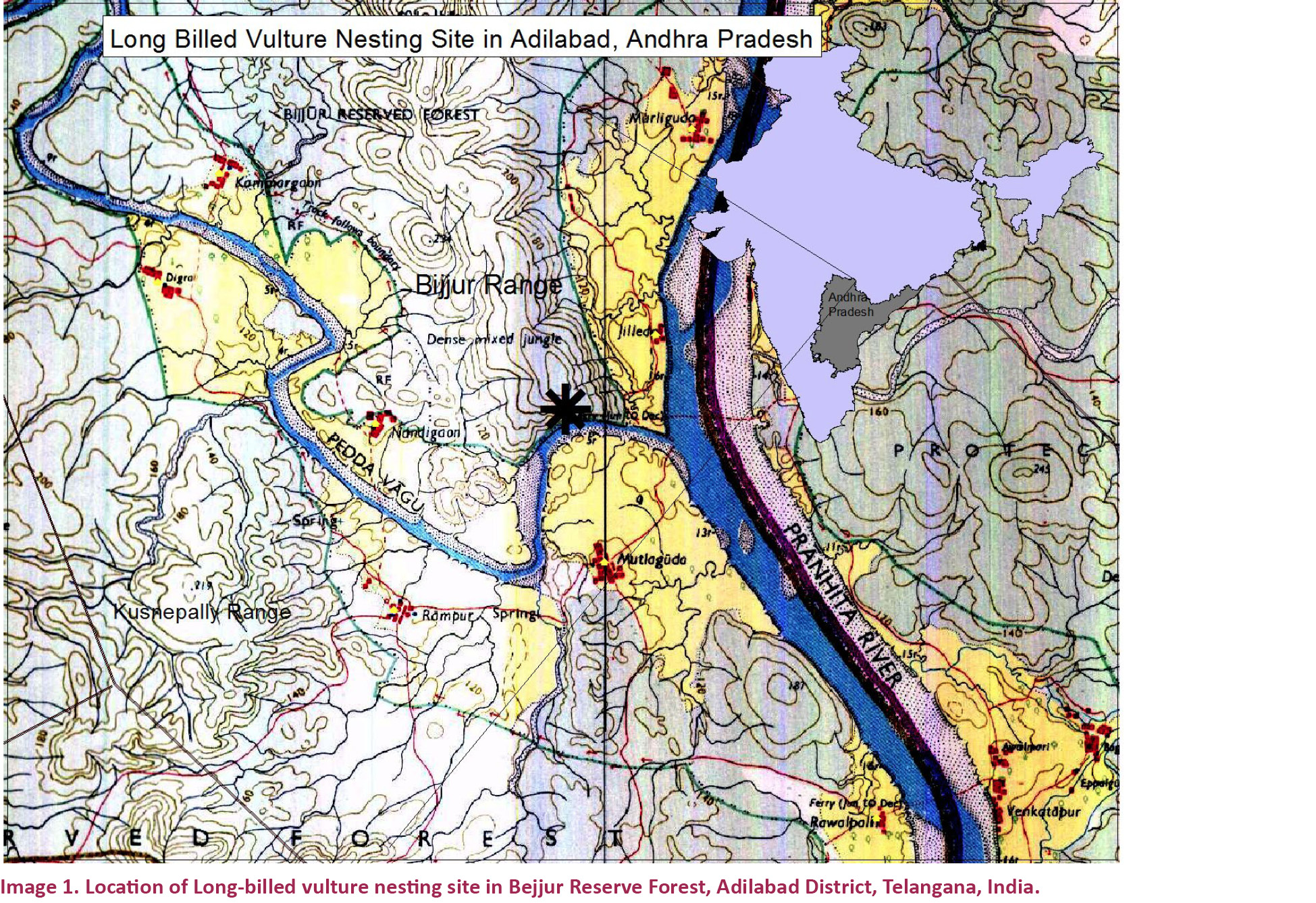
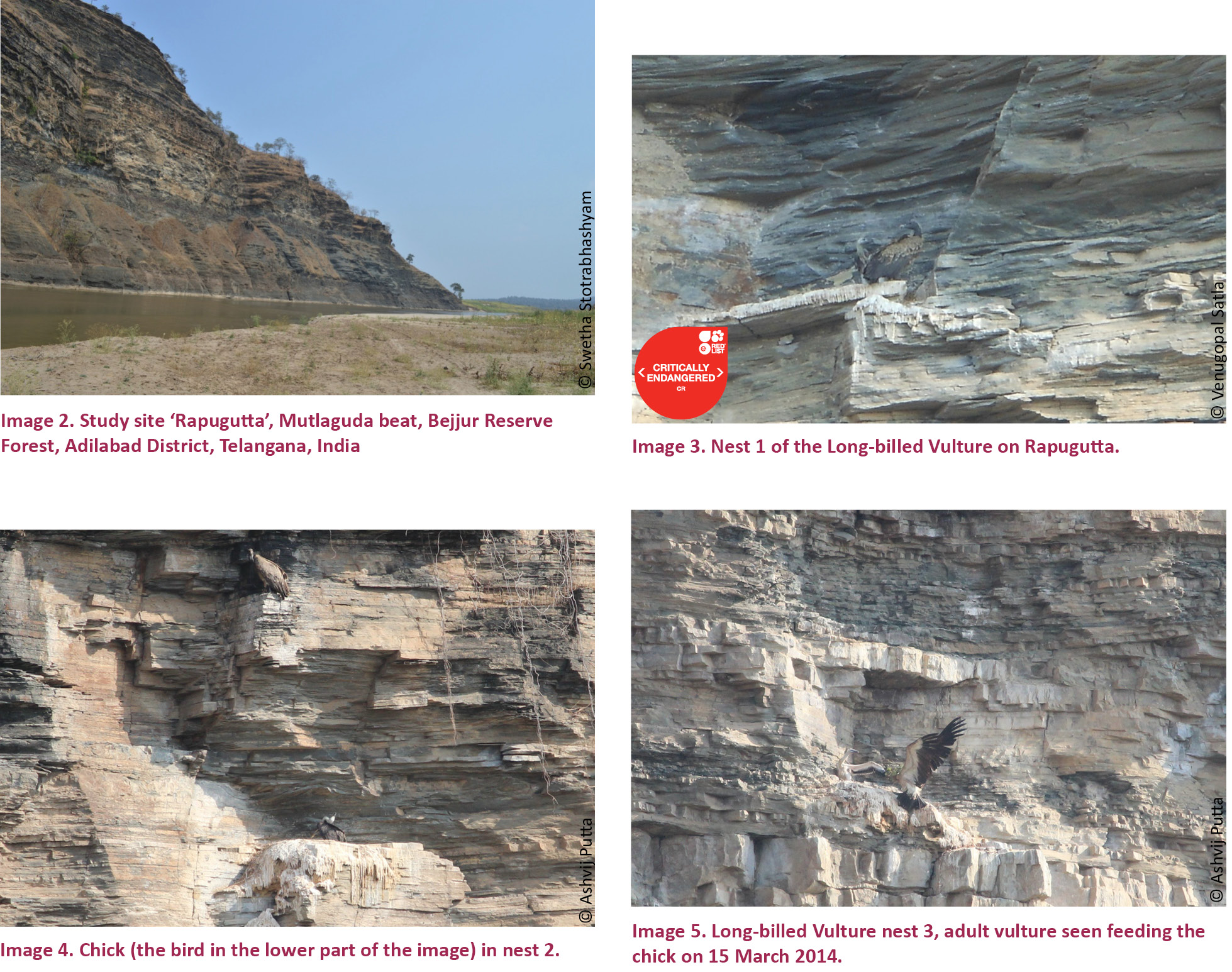
Bejjur, a mandal (an administrative division within a district), lies to the east of Adilabad District of Telangana (Image 1). It is near the border of Telangana and Maharashtra. The forest near the nesting site is a mosaic of dry deciduous, open canopy, and scrub forest types. There are rocky hills along the Peddavagu and Pranihita rivers. The confluence of the rivers, Peddavagu and Pranihita occurs next to a hill called the Rapugutta (Vulture Hill) (Image 2). On the south face of Rapugutta (19021053N & 79091515E) along the banks of the Peddavagu River, vulture nests are situated at an elevation of 80m above the riverbank.
Observations
We observed and counted vultures with the help of binoculars (Olympus 10X) from 40m south of Rapugutta. We also had informal interactions with the villagers of Nandigaon and Motlaguda to understand their perception about the vultures and to understand the threats faced by the vultures.
The locals were aware of the presence of vultures, but few were aware about their nesting and breeding. The observations conducted on 23 and 24 February 2014 revealed the presence of breeding vultures on Rapugutta in Bejjur Reserve Forest. On 23 February, at 1525hr, we sighted the first chick along with five adult Long-billed Vultures on a cliff in the south face of the Rapugutta Hill. This cliff had more than 40 white-washed ledges (indicative of vulture droppings; see Rondeau et al. 2006) which suggested either abandoned or previously used nesting and roosting sites although other species could potentially have caused this. We are not sure if only Long-billed Vultures used the cliff in the past. On 24 February, we observed the Long-billed vultures from 0700hr until 1300hr. Due to the cliff structure and the angle at which we viewed the vultures, it was not easy to observe the adult or the chick. The chicks remained hidden from sight most of the time.
Within the two-day period, we observed a total of five active nests, each nest with at least one parent in attendance. We numbered each nest site from 1 to 5.
The juvenile in nest 1 was three-quarters the size of the adult (Image 3). Its plumage was completely developed (Rasmussen & Anderton 2005) and the head and the neck were white in color. It seemed to be conducting wing exercises and appeared to be ready to take its first flight. Parent 1 was the first to leave the nest at 1020hr. Chick 2 was smaller and creamy white in color. The chick was seen actively preening its feathers. The parent groomed the chick and protected it from direct sunlight by shading it with its wings and did not leave the nest (Image 4). Chick 3 appeared to be the smallest of the chicks (Image 5). We could observe a nest at site 4 on the roosting ledge, but could not see the chick. The adult on nest 4 was disturbed by a Shaheen Falcon Falco peregrinus (Rasmussen & Anderton 2005) that began attacking the vulture at 1100hr. The vulture interacted with the falcon for 20 minutes and kicked the falcon once during this interaction. The vulture left its nest at 1120hr and flew in short circles near the ledge. It was seen being pecked on the head by the Shaheen Falcon during its flight in mid-air and also when it tried to perch at its nesting site. Nest 5 was on the highest part of the cliff. The behavior or size of this vulture could not be studied, as it was not clearly visible from the point of observation.
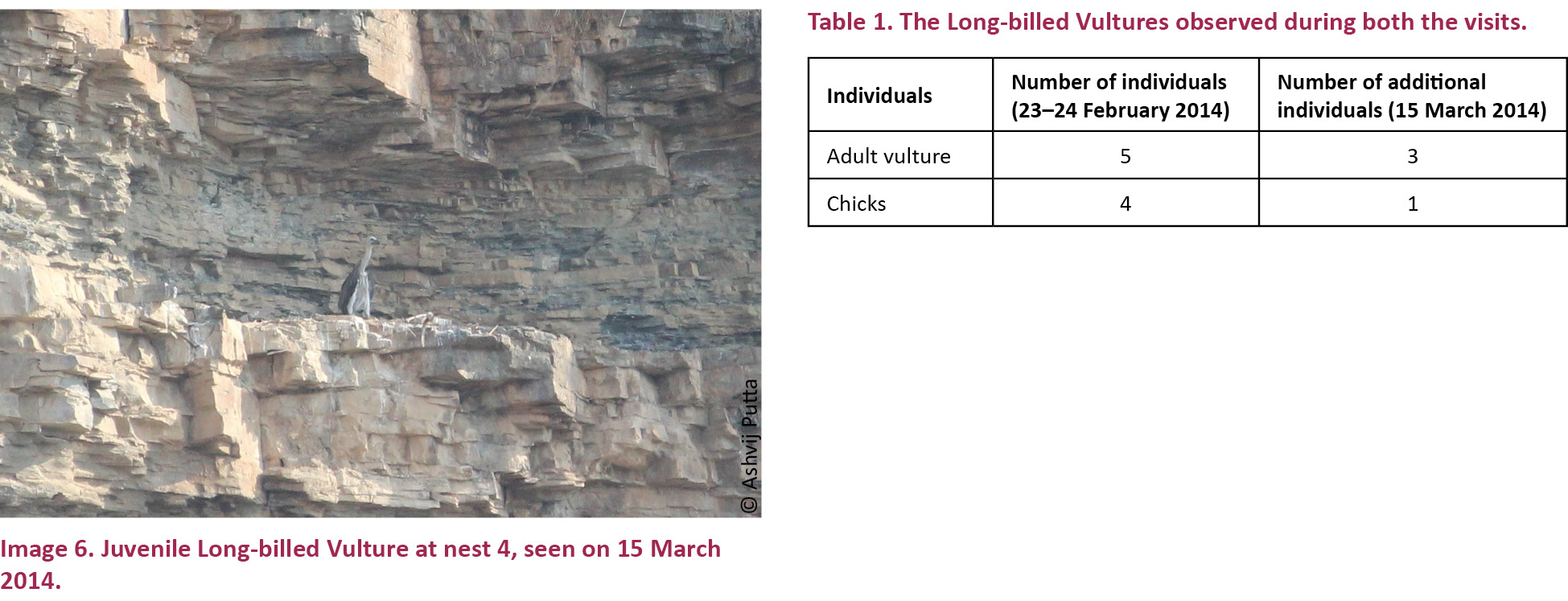
On 15 March 2014, a second team visited the site. They observed that juvenile 4 (Image 6) was as big as juvenile 1 and was also ready for flight. They counted eight adult Long-billed Vultures on the southern side of the Rapugutta Cliff, which is three more than the first visit. Thus, making it a total of eight adult Long-billed Vultures and five chicks (Table 1).
Discussion
There were large white patches on more than 40 ledges, which suggested that the cliff was a regular site for Long-billed Vulture nesting and roosting. Based on documented records, the site appears to be a long way from other breeding sites. The closest documented breeding site to the south for Long-billed Vulture is Ramadevarabetta Vulture Sanctuary (Subramanya & Naveen 2006) which is 997km to the south in Karnataka and Pench National Park which is 425km to the north-west, Panna National Park to the north in Madhya Pradesh, which is 841km respectively, from our current Long-billed Vulture breeding site (Image 7). This implies that the Rapugutta breeding Long-billed Vulture site is quite distant from other known breeding sites. Thus, it could potentially be an important location to protect, as this could be a population vital for the long-term survival of the Long-billed Vulture.
Our informal interactions with the elderly cattle grazers in the villages of Nandigao and Motlaguda indicated that there were around 200 Long-billed Vultures on Rapugutta before 2005, but there were accounts of effluents released into the Peddavagu River by the Sirpur Paper Mills in 2007 and a hail storm in 2004, which killed hundreds of vultures and other wildlife in the Bejjur forests. Most of the villages around Rapugutta use herbal medicines for cattle and they told us they do not use diclofenac. This is hard to verify without proper investigation and questionnaire surveys, and it could well be that diclofenac has also played a role in the declines here as elsewhere in the country.
The locals also informed us that they were now sending old and sick cattle to slaughterhouses. As a result, the food source for the vultures may possibly have diminished, although they may also utilize wild ungulates from the reserve forest. There is a need to explore the possibility of the Long-billed Vultures feeding on wild animal carcasses in this Reserve Forest or from the villages in Telangana and Maharashtra. Detailed studies need to be conducted on these aspects in order to address any related threats, which seem quite likely to be related to food contamination or availability.
Conservation research emphasizing interventions such as declaration of vulture safe zones (Thapa et al. 2009; Mukherjee et al. 2014) need to be initiated and used for long term planning to ensure due protection to the nesting habitats and to make it diclofenac-free. Considering the fact that the population is so distant from other Long-billed Vulture colonies, it is an important population that needs securing from any anthropogenic threats or pressures, and this could be done through the establishment of a community participation conservation model.

References
Risebrough, R. (2004). Conservation biology: Fatal medicine for vultures. Nature 427(6975): 596–598; http://dx.doi.org/10.1038/nature02365
Rasmussen, P.C. & J.C. Anderton (2005). Birds of South Asia. The Ripley Guide, Vols. 1 and 2. Smithsonian Institution and Lynx Edicions, D.C. and Barcelona, 116pp.
Prakash, V., R.E. Green, D.J. Pain, S.P. Ranade, S. Saravanan, N. Prakash, R. Venkitachalam, R. Cuthbert, A.R. Rahmani & A.A. Cunningham (2007). Recent changes in populations of resident Gyps vultures in India. Journal of the Bombay Natural History Society 104: 127–133.
Gilbert, M., R.T. Watson, M.Z. Virani, J.L. Oaks, S. Ahmed, M.J.I. Chaudhry, M. Arshad, S. Mahmood, A. Ali & A.A. Khan (2006). Rapid population declines and mortality clusters in three Oriental White-backed Vulture Gyps bengalensis colonies in Pakistan due to diclofenac poisoning. Oryx 40(4): 388–399; http://dx.doi.org/10.1017/S3065306001347
Green, R.E., I.A.N. Newton, S. Shultz, A.A. Cunningham, M. Gilbert, D.J. Pain & V. Prakash (2004).Diclofenac poisoning as a cause of vulture population declines across the Indian subcontinent. Journal of Applied Ecology 41(5): 793–800; http://dx.doi.org/10.1111/j.0021-8901.2004.00954
BirdLife International (2013). Gyps indicus. In: IUCN 2013. IUCN Red List of Threatened Species. Version 2013.2. <www.iucnredlist.org>.
Chaudhry, M.J.I., L.D. Ogada, N.R. Malik, Z.M. Virani & M.D. Giovanni (2012). First evidence that populations of the critically endangered Long-billed Vulture Gyps indicusin Pakistan have increased following the ban of the toxic veterinary drug diclofenac in south Asia. Bird Conservation International/FirstViewArticle; http://dx.doi.org/10.1017/S0959270912000445
Srinivasulu, B. & C. Srinivasulu (1999) Status of vultures in Andhra Pradesh, India. Vulture News 40: 26–34
Umapathy, G., S. Hussain & S. Shivaji (2009). Status and distribution on vultures in Andhra Pradesh, India. Forktail 25 (2009): 163.
Rondeau, G., P. Pilard, B. Ahon & M. Coundé (2006).Tree-nesting Rüppells Griffon vultures. Vulture News 55(1): 14-22.
Subramanya, S. & O.C. Naveein (2006). Breeding of Long-billed Vulture Gyps indicus at Ramanagaram Hills, Karnataka, India. Indian Birds 2(2): 32–34
Thapa, I. (2009) “An Overview of Vulture Conservation in Nepal.” The Initiation 3(2009): 114–118; http://www.nepjol.info/index.php/INIT/article/viewArticle/2502
Mukherjee, A., T.H. Galligan, V. Prakash, K. Paudel, U. Khan, S. Prakash, S. Ranade, K. Shastri, R. Dave, P. Donald & C. Bowden (2014). “Vulture Safe Zones to save Gyps Vultures in South Asia.” Mistnet 15(3): 4–21 .